Why Commercial Truck Collision Repair Takes Weeks and What Shortens the Wait

When a truck comes back to the yard on a hook instead of under its own power, the decision in front of you is not really who can fix it. It is whether to hand the unit to the closest body shop willing to take it or hold out for a shop equipped for Class 4 through Class 8 work, and the condition that flips that answer is what actually got hit. A bumper cover, a fender, and a mirror arm are a paint-and-panel job almost anyone can handle. Frame rails, cab structure, air lines, and the cooling stack are a different repair, on a different timeline, with a different standard for putting the truck back in service.
Operators who track their own repair orders already know the pattern: a collision job on a commercial unit rarely closes in the same week it opens. The useful question is not why trucks take longer than cars, which is obvious enough, but where in the process the calendar days actually disappear and which of those days you have any control over.
The Three Stages Where Commercial Truck Collision Repair Loses Time
Repair time on a commercial truck accumulates in three places: damage assessment and estimating, parts procurement, and shop scheduling into a bay. Each stage has delay causes that have nothing to do with the other two, which is exactly why total repair time compounds rather than averages out. A slow estimate pushes the parts order back by a week, the late parts order misses the shop's production schedule for that week, and the truck ends up waiting for the next open slot on a job that only involved a few days of actual labor.
Before you can shorten anything, you have to know which stage is holding your truck, because the action that helps at one stage does nothing at another. Calling the shop daily will not speed up a hood assembly sitting in a regional warehouse, and approving a supplement quickly will not create bay capacity that does not exist. It also pays to describe the unit accurately when you make that first call. A rollback carrier, a wrecker, and a light-duty service truck are three different repairs, and an estimate written against the wrong description gets rewritten later.
Why the Estimate Takes Longer on a Commercial Truck
On a passenger car, a competent estimator can write most of the job from what is visible. On a commercial truck, what is visible understates the work almost every time. A front-end collision that presents as a bumper and hood job frequently carries back into the radiator support, the condenser, the charge air cooler, and the brackets and mounts behind them, and none of that can be priced honestly until the front clip comes apart. Damage in that area is not cosmetic either: maintenance guidance published by Truck Repair Information cites Cummins in reporting that over 45 percent of engine failures trace back to cooling system issues, with another quarter tied to improper fluid maintenance, so a tweaked cooling stack is a mechanical problem wearing sheet metal. The practical result is that estimating happens in phases rather than in one visit, with an initial estimate, a teardown, and a supplement written against what teardown finds.
The second phase is where insurance timing enters. Adjusters who spend their days on passenger vehicles are often working outside their comfort zone on commercial values, heavy-duty parts pricing, and the labor times that go with a medium- or heavy-duty chassis, so the supplement goes to a second review instead of a same-day approval. Each review cycle costs calendar days, not shop hours, and those days accrue whether or not anyone is touching the truck.
There is a third condition worth asking about directly. If the shop does not have manufacturer repair documentation for your chassis, it has to source the procedures before it can commit to a repair-versus-replace plan, because decisions like sectioning a frame rail or replacing a cab corner are governed by the manufacturer's published method rather than the estimator's judgment. Ask, at the first conversation, whether the shop has procedures on hand for the chassis you are sending. A shop that answers that question crisply is usually the same shop that writes a complete supplement the first time.
Parts Availability and the Commercial Truck Supply Chain
Parts are the stage operators underestimate most. OEM collision parts for commercial trucks move through regional distribution, and lead time depends on where the part physically sits when the order goes in, which can mean days or it can mean weeks on a low-volume panel. Aftermarket sheet metal is frequently available faster and at lower cost, and for an older unit that is often the right call. The condition that removes the choice is warranty status: on a newer truck still covered by the manufacturer, using OEM parts is what preserves that coverage, and giving up warranty protection to save a week is a poor trade on a truck you plan to run for another decade.
The parts themselves are also not general-market items. Hood assemblies, cab corners, bumper systems, and door skins for medium- and heavy-duty trucks are not shelf stock at a general auto parts distributor, and towing equipment narrows the field further, since boom components, deck and rail parts for rollbacks, and body panels for wreckers and carriers come through the equipment manufacturer's channel rather than a parts counter that mostly serves cars.
What separates a two-week parts wait from a five-week one is usually the shop's existing accounts and on-hand inventory. A collision center attached to a dealership parts operation is already ordering from those distributors every day for its own service work, so the sourcing channel is open and the ordering history exists; a shop without those relationships is opening a new account and learning the catalog on your truck's time. When the estimate is written, ask which items on the list are long-lead and whether they can be ordered before teardown is finished. Getting the known replacements moving early is the single most effective thing anyone does at this stage.
Shop Scheduling and Bay Capacity for Heavy-Duty Work
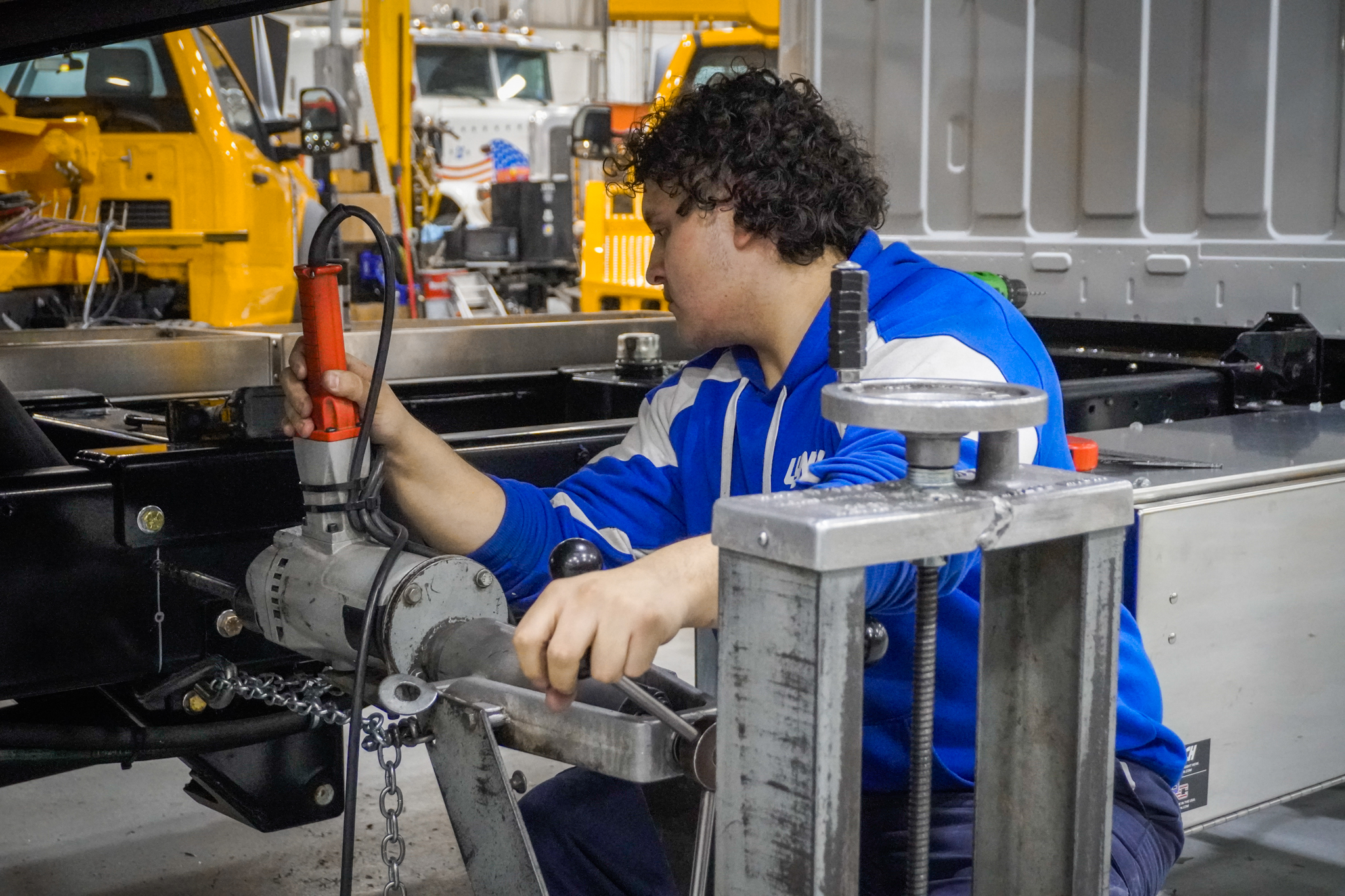
Even with parts on the shelf, the truck still needs a bay that fits it and equipment rated for it. General collision shops run on passenger vehicle volume, and a commercial unit occupies the space and the hours of several lighter jobs, so it tends to get scheduled around that work rather than ahead of it. Frame straightening capability for Class 4 through Class 8 is the harder constraint, since the fixturing and pulling equipment sized for a heavy chassis simply is not present in most general shops, and a truck that needs measured frame work at a shop without it is a truck waiting to be moved again.
For fleets, the constraint multiplies. Sending three damaged trucks to a shop with one commercial bay does not produce three simultaneous repairs; it produces a queue, and the third truck's clock starts when the first one leaves. Shops with dedicated commercial collision bays can run units in parallel, while mixed-use shops share scheduling across everything else in the building. Yard space matters here too, because damaged units have to be staged somewhere while parts arrive, and a shop without room to park a wrecker for two weeks will be reluctant to accept it. Lynch Truck Center's Waterford facility covers more than 40,000 square feet with 30-plus service bays on 20-plus acres, which is the kind of footprint that lets commercial work sit in production instead of in line behind it.
What Fleet Operators Can Do Before the Truck Reaches the Shop
Most of the time an operator can save is saved before the truck is ever unloaded. The accident scene is the only chance to document conditions as they existed, and thorough documentation is what keeps an adjuster from asking for a second look later. The stakes on commercial incidents are not small; the Federal Motor Carrier Safety Administration recorded 5,476 fatal crashes involving large trucks or buses in 2022, and claims on serious incidents get scrutinized accordingly. Photograph the unit from all four corners and from underneath if it is safe to do so, capture the other vehicle and the roadway, and note the driver's account while it is fresh.
Three more actions shorten the calendar meaningfully:
-
Open the insurance claim before the truck arrives, so the shop is not sitting on a completed estimate waiting for authorization that could have been in motion two days earlier.
-
Confirm with the shop that it actually repairs your class and body type before the tow is dispatched, because a truck delivered to a shop that cannot take it needs a second tow, and the second tow costs both the freight and the days.
-
Send maintenance records with the unit at intake, which gives the shop a mechanical baseline for separating collision damage from pre-existing wear when it evaluates hidden damage.
That last item does more work than it looks like it does. Well-maintained trucks run measurably better, and the American Transportation Research Institute's 2023 Operational Costs Report puts the gap at a 26.5 percent lower breakdown rate against poorly maintained fleets, so records that show consistent service intervals also help establish that a cooling or air system fault showed up with the collision rather than before it.
Return-to-Service Compliance After a Commercial Truck Collision
A repair is finished when the truck is roadworthy, not when the paint matches. That distinction carries real financial weight on a commercial unit, because collisions damage things a cosmetic inspection never looks at: air lines routed along frame rails, brake chamber mounts, slack adjuster geometry, ABS wiring, lighting circuits, and mud flap and bumper configurations that inspectors check. Truck Repair Information, citing the Commercial Vehicle Safety Alliance, reports that brake-related violations account for approximately 45% of all out-of-service conditions during roadside inspections, which makes a collision-disturbed air system the most likely place for a repaired truck to fail at the scale house.
Skipping a post-repair inspection is a false economy. An out-of-service order written on a truck you just got back does not just cost the second repair; it strands the unit and its load, restarts the whole downtime clock, and puts the event on your compliance record. Have the air system pressure tested, the brakes inspected and adjusted, and the lighting and electrical verified before the truck goes back on dispatch, and have any cooling or intake components that were disturbed checked against manufacturer specifications, including air filter condition after a front-end impact that pushed debris through the grille. Following the manufacturer's stated intervals and methods pays off in service as well: FleetNet America's Quarterly Benchmarking Report finds that fleets adhering to manufacturer-recommended long-term maintenance intervals see 37 percent fewer roadside breakdowns on major systems.
The reason this matters at the shop selection stage is that a body shop with no mechanical capability cannot perform or sign off on any of it. Someone still has to do the work, and if it is not the collision shop, it is a second appointment somewhere else.
Choosing a Commercial Truck Collision Shop That Fits Fleet Needs
Every delay stage above points back to the same set of questions about the shop itself. Does it carry parts inventory on site and hold accounts with the distributors your chassis and body require, which is what compresses procurement time. Does it have air brake, chassis, and electrical capability under the same roof, or is it a standalone body shop that will hand the truck back cosmetically complete and leave return-to-service to you. Can it coordinate the post-repair inspection so the unit leaves ready for dispatch rather than ready for another appointment. A shop that answers all three the right way turns a multi-stop process into one intake and one release.
That combination is why fleets tend to end up at dealership-connected collision centers. Lynch Truck Center operates a collision center alongside its parts, service, and upfit departments, with more than 35 years in the business and locations connected to Waterford, Chicago, and Denver, and it handles commercial trucks and towing equipment rather than treating them as an exception to a passenger car workflow. The same operation sells and services new and used light-, medium-, and heavy-duty commercial trucks, tow trucks, wreckers, rollbacks, carriers, and towing equipment, which means the people writing the estimate already know the unit and the parts channel behind it. For an operator whose revenue depends on a specific truck being available, familiarity with the equipment is worth as much as the bay.
Scheduling Commercial Truck Collision Repair
Call before the truck moves. A short conversation that confirms bay availability, identifies the long-lead parts on the likely repair list, and establishes what the shop needs from your insurer closes most of the gap between intake and the start of actual repair work. If you have more than one damaged unit, say so on that first call and ask how the shop wants to sequence them, since running them in the right order beats dropping all of them at once and hoping. Have the claim number and adjuster contact ready so authorization is not the thing holding a written estimate, and bring the maintenance file with the truck.
Contact Lynch Truck Center to schedule collision service, order the parts your repair will need, or browse inventory if the damaged unit is going to be out of service long enough that a replacement or additional truck makes better sense than waiting.